FinOps for media buying: how not to lose budget when scaling
Traffic arbitrage has long gone beyond “simply launching ads” and has turned into a полноценный digital business. Today, media buying teams work with dozens of advertising accounts, test various GEOs, and operate with large budgets. In such conditions, chaotic financial management quickly leads to loss of control over expenses and decreased profitability.
Example from practice: A team with 50 Facebook accounts loses $500/day due to mixed budgets and chaos with cards.
FinOps helps bring order to finances and scale without unnecessary losses.
What is FinOps in media buying
FinOps (financial operations) is an approach to financial management that ensures transparency of expenses and control of cash flows during operations.
In media buying, this includes:
- budget allocation
- card management
- payment control
FinOps = a systematic approach to expense management
What breaks without a financial system
Without a clear structure, typical problems arise:
- one card is used for different accounts
- budgets get mixed (testing and scaling)
- lack of control over individual bundles
- it is difficult to evaluate spending efficiency
Result: losses of up to 30% of the budget + risk of bans.
How to properly allocate budgets
One of the key principles of FinOps is separating budgets by tasks.
Basic structure:
- testing budget — for finding bundles
- scaling budget — for effective campaigns
- reserve — for restarts and unforeseen expenses
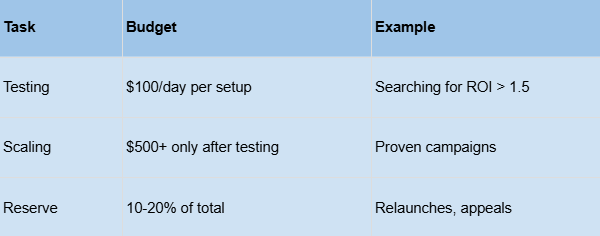
This approach reduces risks and speeds up decision-making.
Cards and payments without chaos
Effective work with payments requires a structured approach to using cards.
Optimal model:
1 card = 1 advertising account
This ensures:
- transparency of expenses
- accurate accounting for each campaign
- reduced risk of bans
Real case: A team issues 50 cards in 15 minutes and sees ROI for each account separately.
The role of payment infrastructure
An effective FinOps system is impossible without reliable payment infrastructure.
Services like Pay2.House provide:
- issuance of 100+ cards in minutes
- budget distribution across the team
- centralized expense dashboard
- API for automation
What a minimal FinOps system looks like
The basic financial structure includes:
- one main balance
- budget allocation by tasks
- separate cards for each account
- regular expense control
3 rules of effective FinOps
1. Budget separation
Testing and scaling must be financed separately.
2. Regular expense control
Monitoring should be carried out daily: 5 minutes in the morning = $1000+ saved.
3. Gradual scaling
A sharp increase in budget often leads to losses.
Conclusion
FinOps is a basic financial management system that allows you to control expenses, reduce financial losses, and effectively scale advertising campaigns.
In modern traffic arbitrage, financial discipline is becoming one of the key factors of profitability.